Monday, 29 September 2014

'Riot Club': David Cameron & UK Election 2015


Powerful yogas in David Cameron's chart show how he rose from back-bench obscurity to lead the Conservative Party, and then on to become Prime Minister. Despite his privileged background, he was very much the outsider when the Tories chose their new leader in 2005. In ancient times, as today, it was the leader who was able to sway the masses with oratory who became King. Witness Barack Obama's rise in the USA, based largely on stirring rhetoric.


Cameron's 9th Ruler Venus forms a powerful link with friend Saturn, ruler of the 5th house of statecraft, on his 1st-7th axis. Significantly, he became Prime Minister during his Venus-Saturn period in 2010, as transit Saturn also crossed his ascendant. Venus in lagna, despite its debilitation, is strengthened by a Parivatana yoga with chart ruler Mercury in Libra. Cameron first caught the nation's eye in a televised debate with other Tory contenders, with Mercury in the 2nd giving him a notably smooth and articulate voice. 


Venus dasha has done well for Cameron, clearly. He went from his pivotal Venus-Saturn period to Venus-Mercury in February 2011, triggering the karma-dharma adhipati yoga between the 9th and 10th rulers. He came to power with the UK in the grip of an historic recession and started a program of drastic spending cuts. A Labour government might have sold this policy more readily, but the Tories had a political problem, especially with a cabinet full of old-money Etonians. Yet he was able to govern relatively unchallenged, due largely to his fortunate astrology.

Private wealth is also shown in Cameron's chart, along with an advantageous marriage. Exalted seventh ruler Jupiter joins Moon in its own sign in the 11th house of revenue. Samantha Cameron comes from an even wealthier and more aristocratic background than him. Despite sixth-ruler Saturn placed in the seventh with a stressful aspect from Mars, this Moon-Jupiter signature would strengthen any relationship, financially and emotionally. 


So he has ridden an astrological wave, despite being seen as a relatively characterless, identikit posh Tory. He has presided over a coalition government in times of austerity, and the country is now held - by some - to be heading towards financial recovery. Next February, however, sees Cameron hitting his Sun mahadasha, which brings an altogether different tone. 

Intriguingly, this coincides with a UK Election year, with the country going to the polls in May 2015. Sun is Cameron's 12th house ruler, not an auspicious signature for a leader. Placed in 1st house shows his outwardly confident, some would say bullying style, but it may also conceal hidden weaknesses. Any skeletons in his closet will likely come out during Sun's period, especially with Mars also in the 12th. Perhaps exploits from his 'Riot-Club' past at the Bullingdon?

Bullingdon Club in 1980s, Cameron 3rd left, Boris Johnson seated with umbrella.

Cameron will not have the same luck as 2010, even though he does not presently face strong opposition. Labour leader Ed Milliband is perceived to have a charisma problem, while the Tories' coalition partners the Liberal Democrats have not enhanced their appeal in power. If the UK's slow recovery continues, people may simply look to the bottom line and vote for Cameron as the least-worst option. 

Yet even if he triumphs again, his second term will be rockier than his first. Lagna flanked by Mars and Ketu shows delicate health, exacerbated by a direct aspect from 6th house ruler Saturn. Saturn also aspecting its enemy Sun is also not promising for Sun period. The Tory Party is notoriously ruthless with its leaders, and Cameron's enemies this time are more likely to come from within his own camp - might we finally see a challenge from his ambitious fellow Bullingdon Club old-boy Boris Johnson?


Wednesday, 10 September 2014

Happy Days: Six strong planets this weekend.

There's been a lot of negative press about over the summer, with hideous images splashed over the front pages of the papers and the world apparently falling to bits. Especially shocking considering this is traditionally 'silly season', when politics is on recess, everyone is on holiday and non-news hogs the headlines.


Ironic in light of the amazing lineup of planets this coming weekend, September 14-15. No fewer than 6 planets are in either their own sign or exaltation: Sun in Leo, Moon in Taurus, Mercury in Virgo, Mars in Scorpio, Jupiter in Cancer and Saturn in Libra. Rahu's exaltation is a controversial topic, but in Virgo it sits well at very least. Even the odd planet out, Venus, is strengthened by its dispositor, Sun.

Jupiter and Saturn are still aspecting each other in their respective exaltations, a situation we have not had since 1955. This is a very auspicious time for new plans and projects. Make a resolution and the power of the planets will support you.

Babies born at this time will have extraordinary potential. At a time of rising consciousness, the new generation come into the world when the time is right, ready attuned to higher knowledge. 


Monday, 11 August 2014

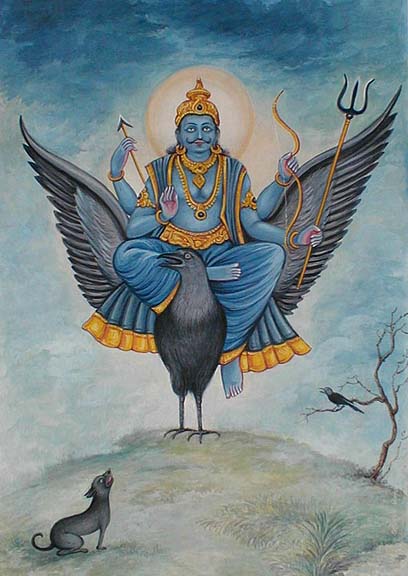
Saturn: Myth and Mind Level


Saturn is in its sidereal exaltation in Libra until November. Some thoughts on his influence from my book Saturn, Fatal Attraction


Western astrology takes its symbolic cues from ancient Greece and Rome, but the motifs of Saturn have parallels in myths from all over the world. For example, Saturn has a great deal in common with the Yogic concept of Maya. Maya is the interplay of the whole material world, which at the most exalted spiritual level is realised as illusory. Buddhists may recognize this as pure Mind; an objectified cosmic dream, which ultimately is only dispelled by reaching Enlightenment. Perhaps it is unfair to saddle any one planet with this burden, but Saturn is the ruler of base materialism and the temporal world. This is consistent with the portrayal of Maya as the trickster who ensnares us in his web and the personalised Biblical representation of the Devil himself. Eastern philosophy says that the appearance of Maya is due to ignorance, which is in turn the ultimate cause of suffering. The level of understanding at which we perceive Maya determines the extent to which it is real. So at last, the world is pure ideal, but few of us live from day to day at this supreme level.


Saturn, in either his natal or transiting position brings us up against apparent obstacles and frustration, but like the experience of Maya, these boundaries are in fact only provisional. We give Saturn’s shadowy limitations greater substance to the extent that we identify and run away from them. The restrictions of fate and time are relative, and by working positively and facing the challenges, a man eventually makes himself free of Saturn’s bonds. A stressfully aspected natal Saturn is one that cannot operate without a certain amount of adjustment, which makes effort more intimidating, and results take longer to achieve. But working at Saturn in any condition is never time wasted. Ensnaring ourselves in a tangled, tenuous world on the other hand, around the refusal to recognise the consequences of our own behaviour, is the worst possible approach, as is illustrated by the myth of Saturn-Chronos.


Chronos
To recap: The Greek Saturn, Chronos, took his mother Gaia’s part against his tyrannical father, Uranus, the Sky God. Using the sickle given to him by Gaia, Chronos castrated his father and usurped his title King of the Gods. Chronos then held supreme power, though with his head lying uneasily for constant fear that someone would in turn overthrow him. He proceeded to eat all of his children to prevent a celestial palace coup, which did not endear him to his wife Rhea, who hid their son Jupiter until he was strong enough to stand up to the old man. Young Jupiter then brought his father’s fears crashing back to him by seizing power, banishing Chronos to the earth and establishing himself as the Olympian King.

A good story, but what does it all mean? There are many interpretations, among which the idea of the ‘Sins of the Father’ is instructive. Saturn hated his father and rebelled against him, yet he re-enacted the same pattern with his own children, with the same disastrous consequences. Whether it is a strictly fated occurrence, or a product of environment and conditioning, how often do people fall into exactly the parenthood traps that they vowed never to repeat? Or, like Chronos, they feared their own parents and feel it incumbent to ensure that their own children are frightened of them. On a more esoteric level, karma is in fact handed down through bloodlines. When a father dies, the unresolved karma from his last lifetime is passed on to the next available material vessel, his children. 


Pandits performing a Saturn puja 

The myth also says something about Saturnian ambition and his willingness to take responsibility: Chronos decided that something needed to be done about Uranus and at the same time, saw an opportunity to make something of himself. This is characteristic Saturn-influenced behaviour. Saturn defines himself in terms of status or standing, and will go to great lengths to accomplish his goals. It does not always mean taking such large risks as Chronos, but opportunism is a big motivation. Once a man has arrived in a position of authority, he may become a beneficent boss, or an overbearing despot. Either he helps others get along, or pulls the ladder of opportunity up after him, for fear of being emulated or overtaken. The wise Saturnian chief realises the karmic consequences of his actions and that by helping others he helps himself. As the I Ching says, ‘To rule truly is to serve’.

Chronos’s attitude towards his children also illustrates the Saturnian propensity to hate or reject the things that we have created. People also hate the things that they fear, so Saturn frequently represents a fear of creativity or self-expression. We wish for a lasting legacy through our Saturnian effort, but the struggle to give birth to an idea, career, or any attainment at all has been so difficult that we have little subsequent love for it. Likewise, once Saturn has transited a natal house, we are heartily sick of its mundane affairs for a long time afterwards.


Most of all, though, the myth of Chronos depicts Saturn’s capacity for projection through fear. Saturn toppled his own father, which means someone will topple him and at some guilty, half-conscious level he knows it. He tries to avoid his fate by controlling his environment, and becomes a tyrant in the same way as his father. If he had been a more modern parent and perhaps talked to his children instead of eating them, Chronos may have remained King, but perhaps even Gods have their high-level karma to live out. Fear manifests itself, and the steps Chronos took to avoid his fears only set up the inevitability of them coming about.

Psychologically speaking, it is common to see Saturnian problems on the birth-chart mirroring the mythic Chronos and stemming from negative projections about the world that become cruel self-fulfilling prophecies. This is classic Saturn in his archetype as the Devil or trickster. The stratagems and mechanisms used to avoid the perceived pain and problems of Saturn, as represented by his sign, house and aspect, appear to be the very things that bring them about. Avoidance of Saturn, or of fate if we prefer, eventually leads to a degree of overcompensation, and here we are caught in the very behaviour we are most afraid of. Saturn causes most hardship when acted upon, or reacted to out of fear, and while we may experience difficulties in any case, looking at Saturn as if through the gaps in our fingers virtually guarantees we bump into every possible obstacle. The image of fate is like being pursued by a speeding train: we can run away for a while, but it will surely catch up and it is much easier if we simply jump aboard. The changes will happen anyway.


To use a very simple example, people with Saturn in Pisces or perhaps the Twelfth house ouhouare said to be afraid of institutions and confinement. So they may refuse a doctor’s appointment if there is the slightest fear they will have to go to hospital. This continues until it becomes absolutely imperative they be committed, where they end up spending far longer than if they had been checked out at the first sign of trouble. Or take the individual with Saturn in Aries who is frightened of asserting himself. He fears that nobody will like him, yet he manifests this fear and becomes unpopular by boorishly overcompensating for his natural reticence. There are numerous mundane examples of this Saturnian projection: people carry guns or knives for fear of meeting somebody else as paranoid as themselves. In political life, a government’s defence budget is in direct proportion to the amount of fear prevalent in the world. Yet the more arms are created, the more the sum of global anxiety increases. There is a fine line between facing fear and the sense of hubris and reckless overcompensation that are its opposites.


Saturn’s tale is set against the backdrop of his father and his children, but echoes of the myth are not restricted solely to family scenarios. People coming up the hard way in their career often achieve success through precisely the early privation and lack of emotional stroking signified by Saturn. ‘Sweet are the uses of adversity’ perhaps, except the fruits are often rather sour. A chip on the shoulder, perhaps in the form of a prominent square or opposition to a personal planet, provides the future Saturnian big shot’s incentive for success. Using his discontent for positive motivation is very well, except the sense of perpetual grievance may remain even after he has ‘made it’. Upon arrival in the Promised Land, the thrusting Saturnian type turns the tables on his former oppressors, which in his distorted reckoning includes almost everyone, by way of projecting his shadow outwards. Nobody is left in any doubt who is the new boss. If he becomes a truly tyrannical figure, he may set himself up for a fall after the fashion of Chronos, but this is of course Shadow-influenced behaviour at its very worst. Difficult natal aspects from Saturn need not manifest this fully-blown megalomaniac sense, but Saturn’s myth merely provides a cautionary tale of behaviour to guard against.

There is a kind of reverse sympathy at work here – a fatal attraction or unsympathetic magic that determines that a man’s unconscious, unwanted scenarios get played out despite himself. No matter how unfashionable or unpalatable, there is a suggestion that the experimentation undergone through Saturn’s lessons cannot be completely avoided. We are all conditioned by karma to some extent. While confining him to the closet merely means that Saturn is expressed in a negligent or unwitting way, if Saturn signifies fated occurrences and work that has to be done, then there is nothing to be gained by trying to avoid the issues that he represents on the birth-chart. Boundaries and hard work are necessary elements to life too, and evasive manoeuvres usually mean the portal door swings back doubly hard on the rebound.


Thursday, 7 August 2014

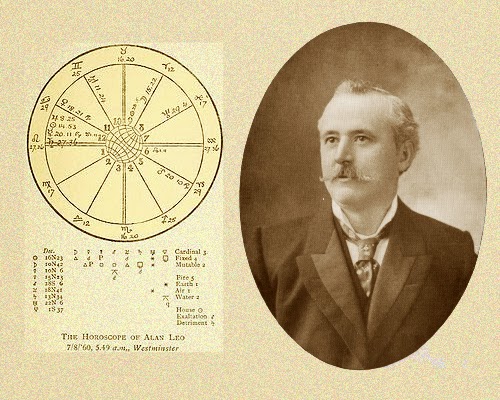
Alan Leo, Godfather of Modern Astrology


Today is Alan Leo's birthday, born this day in 1860. This article is adapted from my book, Saturn, Fatal Attraction, with some extra interpretation from a Jyotish standpoint.

Victorian astrologer Alan Leo (William Allan) had, famously, a natal stellium in Leo, including Saturn rising, closely conjunct his ascendant. He was in the forefront of the Theosophical movement in the early 20th Century and his prosecution for fortune telling in 1917 proved a landmark case for the practice of astrology. Leo ran a thriving mail order horoscope service, but became a victim of his own eminence when he was sued by a disgruntled client under The Vagrancy Act, an English statute of 1824 that effectively outlawed professional astrology[1].


Leo’s trial took place at the approach of his second Saturn return, specifically as Saturn entered his natal Twelfth house. In court, he made a good witness and escaped with only a nominal fine, even though under the Act, he could technically have been imprisoned with hard labour (yes). Jupiter in his natal Twelfth house seems to have spared him this fate. The upshot was that Leo decided to rewrite his extensive back catalogue of books and personal horoscopes, rephrasing his traditional predictive style in favour of a 'trends and tendencies' approach. This had apparently been his long-term intention in any case, but the lawsuit was a compelling motivation for him to expedite the work. So influential an astrologer was Leo that others followed his Theosophically-inclined direction and the impact of the Mansion House case has reverberated through astrology to the present day.

A possible reading of this affair is that Leo brought the lawsuit upon himself by a kind of unconscious intention. He did not wish to be prosecuted, of course, but as an example of Saturn’s transit of the Twelfth house, where latent fears and karma are played out in a quite distorted fashion, he became the instrument of a larger destiny. In the event, Alan Leo did not live to see the revision of his work completed, for he died within the year, as Saturn approached his natal Sun. 

************************

Jyotish Chart: 7th August 1860, 5:47am, London UK. 

There are very few famous astrologers in history, so anyone who has made a name for himself in the field is fairly sure to have a powerful chart. This is borne out in Leo's case, with Lagnesh Moon in parivartana yoga with exalted Jupiter in the first house, an outstanding, textbook Raja Yoga. This combination promises wealth, fame and protection through higher knowledge and publishing. 

Noteworthy too is Yogakaraka Mars in the Sixth house of lawsuits, in a karma-dharma adhipathi yoga with Venus in the 12th house. The famous legal battles for which Leo is best known occurred in his Mars Mahadasha, which began in 1912. This was the height of astrology in Edwardian England, when the Metropolitan Police Commissioner issued an order that fortune tellers of all types within his jurisdiction must remove all words such as "palmist", "clairvoyant" and "astrologer" from their doorplates, window signs and other public advertisements. Public concern was heightened enough for questions to be asked in the House of Commons in 1911 and 1912. (Biography of Alan Leo, by Kim Farnell www.skyscript.co.uk)


Leo's first prosecutions for fortune telling came at Mansion House Magistrates Court February and April 1914, during his Jupiter antardasha. This protective influence may have been instrumental in the case against him being thrown out, though costs were awarded against him. His second trial in mid 1917 came during Venus antardasha, and was not so fortunate. Leo's counsel made unsuccessful attempts to engage in philosophical arguments vis-a-vis astrology, and their 'trends and tendencies' defence foundered on a statement from one of his almanacs:

At this time a death in your family circle is likely to cause you sorrow.

This was an open goal for the prosecution: "Was this death a tendency, or was there a tendency to be dead?" Despite impressing the judge with his character, Leo was found guilty and fined £5 with £25 costs (about £2000 in today's money). The charges against him carried a possible custodial sentence with hard labour: Venus in the rasi 12th brings the threat of imprisonment, and Leo's friends believed the stress of the case was a contributor to his untimely death only a month later. 

Many people today believe Alan Leo has a lot to answer for, and the impact of the Mansion House Case was a - negative - watershed for astrology. It is hopefully not too melodramatic to see that he acted as a kind of sacrificial channel for the future of astrology. If this is a fatalistic reading, the irony is that astrology became decisively less fatalistic as a result and maybe it is this new movement that was striving to get out.


[1] Anyone practicing fortune telling was defined as a ‘scoundrel and vagabond’ and repeat offences made them ‘an incorrigible vagabond’(!)

Thursday, 10 July 2014

Argentina v. Germany: World Cup Final 2014

I'm using a Western horary for this, simply because it happened to be up when I thought of the question. This isn't the chart for the kick-off on 13th July, but I'm still using contest rules to judge it. 


Germany, 4/6 favourites with William Hill, are shown by ascendant ruler Mercury, at home in Gemini in the 10th. Mercury is void of course but this is still an apt token for the team of the tournament so far. 

Argentina are shown by Jupiter, exalted in Cancer, which raises an interesting point: which is stronger, a dignified or an exalted planet? I suggest angular Mercury (Angela Merkel?) in Gemini shows the form team Germany, working well together, with everything as it should be. Jupiter in Cancer, however may hit greater heights, at least in the short term. This is Argentina, relying on the brilliance of one player, and this placement also shows: he may deliver.

Who will win the World Cup? 10th July 2014, 10:09 BST, London UK.


Both significators being void says form will go out of the window. The final will be won by whoever plays best on the night. VOC often means 'nothing will come of the matter', which translates to a victory for the status quo. This is a further nod towards favourites Germany.

Before looking at the astrology, I thought Germany were nailed on. They have to watch out for playing too rigidly and conservatively or relying on their system too much. They may also have peaked after their semifinal demolition of Brazil: unlikely, but possible. The chart suggests Argentina are well in this final, however. They have to watch out for being overconfident, too emotional and leaving too much to Lionel Messi.

Incidentally, Mercury and Jupiter are in the same signs in both zodiacs. The horary ascendant moves back to Leo, so the sidereal significators are Sun and Saturn. Saturn, exalted in Libra gives Argentina the edge.   

Kick-off time chart. 
The Vedic chart for the contest shows the significators reversed. Here it is Germany represented by Jupiter in Cancer, and Argentina who are Mercury in Gemini! Jupiter in the 8th however, aspected by Saturn, is not in such good shape. This suggests it is Germany, rather than Argentina, who may disintegrate, or else suffer a key injury or setback.


World Cup Final: 13th July 2014, 21:00 BST, London UK.

It's hard for a football fan to detach from the sporting side and judge a contest purely on the astrology, but this is precisely what astrology is for. Germany have been the best team in 2014 and it is probably Argentina who will be looking from help from the stars. They have a slight edge in this respect, but not enough to make a difference. So I will stick with backing Germany, even though the contest will be closer than I, and possibly the bookmakers, think. A repeat of the 1986 final will be a victory for football. 

Pedant's Corner - Have you noticed how sports commentators often say a team or player doing well is "in the ascendancy"? They mean 'in the ascendant', of course, astrological parlance for being favourite to win.

Postscript, 13th July.
Think this horary + the event chart summed the game up. Very close all the way, with Germany just shading it. I was right about Germany getting injuries, but wrong about Messi showing up. You could have called it for Argentina purely on the astrology, but they would have needed Germany's star to be weak as well as their own being strong. Germany worthy winners overall.


Wednesday, 2 July 2014

Why Vedic Astrology?


Since about 2012 you may notice I have moved to a more visible practice of Vedic Astrology. Never mind that I’ve studied Jyotish for many years, stemming from my long-standing involvement in yoga, it may still seem to some people as if I have been suddenly radicalized. In fact, the reaction to my new ‘orientation’ (orientation means facing the East) has taken me by surprise. I have encountered everything from delight through confusion to open dismay, and with this in mind, I thought it would be in order to set out some of the reasons for my shift. 


There is a tendency among Westerners who have become infatuated with Indian thought to overlook or dismiss areas where their own culture provides perfectly good answers. Likewise, some astrologers invest fairly pedestrian insights with great profundity simply because they come from a Vedic horoscope. It seems grander and more esoteric somehow. Truth is truth, however, and different systems reflect the same things from different angles. So this article is not intended to be a Diktat declaring the supremacy of one astrological perspective over another.

Some people assume that I have made the change to distinguish myself from the thousands of other fine astrologers out there. Good theory, except I’m bound to say I have embraced Jyotish because of the extra insight and depth it gives to chart interpretation. Vedic astrology has provided answers to many problems I have encountered with the Tropical system, plus a few unexpected surprises of its own. I still respect Western and use the outer planets, geometric aspects, composites, MC/IC, secondary progressions and the rest, but any astrologer can surely benefit from the advantages Vedic technique offers.

************

The Western astrologer’s trepidation on first confronting Jyotish is understandable on several counts. Despite much common symbolism, the experience combines learning new techniques with learning a new language or dialect. ‘Lagna’, ‘Gochara’, ‘Drishti, what are these strange-sounding terms? Nothing more than ‘ascendant’, ‘transit’, ‘aspect’, yet adapting to square charts and a new astrological reference point is at first like learning to write with your left hand. 


The sidereal zodiac, however, is the main adjustment for those who are already quite comfortable with their existing symbolism: “I’m Gemini, not Taurus, what’s all that about?”, and it does not help that adjacent signs are so different. People who readily identify with their tropical placements often claim they don’t feel the same intuitive fit with sidereal signs. However, I would say this is a matter of conditioning. Take two people who have, say, tropical Aries rising; one with 28 degrees, the other with 10 degrees. The first person will have Aries ascendant in both zodiacs; the other’s ascendant will move back into sidereal Pisces. The difference will be perfectly evident!

The blunt, declarative style of Jyotish is yet another culture shock. Dire pronouncements on disease, poverty and death are Western taboos that our astrology left behind before the turn of the 20th Century. ‘Fortune-telling’ represents everything that our present hands-off, humanistic astrology is against. Still, in the bargain we have lost all notion of assessing a personality’s intrinsic worth and personal good fortune. Does the astrologers’ art not lie, after all, in judging a horoscope? A little learning is dangerous, and discretion, as ever, is vital.  There is no excuse for making reckless, unsupported statements and being a stupid astrologer.

In any case, giving a planet or house ‘malefic’ status, simply points out that it carries the potential for suffering, experience which most people prefer to avoid: debt, pain, illness, loss. Why is this taboo? Any language of life that excludes these experiences is not worth the description. Astrology loses its clarity and power if the text is already set out in shades of grey. Balancing a chart’s conflicting testimonies, weighing the evidence, is where the astrologer’s skill lies. By contrast, the current New Age attitude is that we only have to think positively and our lives will never be touched by illness or tragedy, and we will all live forever.

We are not intended to take classical Jyotish aphorisms too literally in any event, but they are expressed in black and white language for the astrologer to blend in interpretation. Intuition is vital in this respect, and it is also recommended to study Jyotish with an experienced teacher. Symbolic insight grows out of the astrologer’s relationship with the planets and our Jyotish-Mati Pragya, or expanded consciousness, is a quality to be cultivated positively. Most Vedic astrologers practice yoga of some sort, being engaged in a parallel program of self-development over and above the ‘talking cure’. (They generally drink a lot less, too). Mantras and invocations to the planets, for example those ruling the days of the week, are a part of the astrologer’s lifestyle and the experience of studying the stars takes on an interactive, Shamanic quality.


A Western astrologer, particularly one versed in traditional and horary techniques, will recognize many of the Jyotish fundamentals. House Lords play a more central role in interpretation and define the myriad planetary combinations, or Yogas, that are the jewels in the crown of the Vedic system. One tends not to analyse a planet’s sign qualities per se, but rather to check which houses it rules and its dispositor. Analysing house rulership comes into sharp relief with Whole Sign houses (a system now championed by many Western astrologers), and that system’s elegant simplicity is particularly evident when used with the sidereal zodiac. In any case, combinations of certain house lords may denote wealth, fame or influence, and make an altogether auspicious chart; a notion that Western astrology seems to have lost.

Whereas Tropical astrology sees ‘luck’, good karma or God’s grace as imponderables, insight into this area sits at the heart of Jyotish. Yoga philosophy declares that good fortune comes from past-life credit, but whether or not you follow this concept the astrological technique holds true. One can spot straightaway individuals with political clout or a wealthy family, or those who have the power to rise up beyond their origins. How useful is this? Without this vital dimension, charts are ‘flat’, with no way to tell whether the subject will be a leading figure in their field, be it CEO, movie star or head salesman. Not everyone with Raja Yoga – a ‘king maker’ - in their chart will become a superstar, but superstars’ charts invariably possess potent Raja Yogas.

This fatalistic outlook is a cringe for many Western observers, with the implication that without the right chart signature one is doomed to a life of mediocrity. Yet from experience we know not everyone will become a big shot: take two people of the same age, similar background and intelligence, who both leave University the same year. One person finds influential contacts, shoots up through the ranks and makes a fortune. The other, while at least as able, has a greater struggle and works twice as hard for three times as long to achieve a fraction of his friend’s impact. Nobody gets a perfect life, perhaps, but some people are very lucky: this is the perennial story, and astrology is supposed to say something about it.


An integrated life, in any case, does not depend ultimately on worldly status. Jyotish is highly revealing about this too: we can see people who struggle all their life for outward influence, yet make great spiritual progress. Some people have a happy temperament, others fall in the mud and end up smelling of roses, and this too is shown in Vedic astrology. Money and influence are useful – vital -  but the pressures of being a world leader or cultural icon are enormous, and material distractions beyond a certain point may become a positive curse. Fulfilling one’s own destiny (dharma) and becoming self-realized, ultimately, is the only thing that matters.

Far from lamenting that we cannot readily spot an eminent person’s chart,  Western Astrology has made a virtue of necessity. We boast astrology is not solely about prediction because it is increasingly beyond the scope of our system. Our modern mantras are: “We have infinite choice, everything is relative; knuckle down, keep smiling, and you too can have it all”. Western astrology talks about ‘easy’ or ‘difficult’ charts, usually based on the predominating aspects, and it can spot vocation, relationship preferences, good and bad times, and all manner of psychological syndromes. It's good stuff, but it is like a page of prose full of adjectives without a main verb. It might say, “This person could be an artist”, whereas the Jyotish chart says, fairly, “This person could be a successful, celebrated artist”. Qualitative and quantitative.


it is common to hear, ‘Tropical astrology is good for psychology while Jyotish is better for prediction’. I always thought this was a curious statement, does it not depend on the astrologer; why should this be so? Even a cursory acquaintance with the main Vedic planetary period system, the Vimshottari Dasas, makes one appreciate how much more closely accounted for fate is than Western astrology allows. It’s not fatalistic, it’s realistic. Dashas give us not only sporadic and intermittent transits and progressions, but whole periods of time ruled by specific planets and their aspects. We then look at transits and progressions in a more specific context, which helps to explain why a major event; a Jupiter return, say, might bring very different results from the one twelve years previously, or hence. 

In Western natal astrology, Exaltations and Falls have become increasingly meaningless, to the point where some authorities question their provenance or have discarded them altogether. Whether it is because four-fifths of the time we are not using its actual astronomical placement, the power of an exalted or fallen tropical planet is rarely self-evident. In Jyotish, we can see the quantifiable effect of a strongly or weakly placed planet, to the point where its power can be expressed in percentage terms. Tropical reveals the style, sidereal the substance.

Take a tropical chart with Moon in Sagittarius, which may be considered fairly blessed – a buoyant, positive inner life that finds its emotional centre in a philosophical outlook. Yet, this usually translates to a sidereal Moon in Scorpio, an altogether different proposition. A Western astrologer might describe the Moon in Scorpio as ‘passionate, secretive, compulsive’. True too of sidereal, but it will also describe the debilitated Moon as a material influence on the individual’s health and happiness, affecting the success or failure of the Moon’s mundane house matters, plus those houses it rules and aspects. Sure, there are mitigating factors - to the point where this Moon can work as a quasi-benefic - but the picture in any event is more detailed and factual.


A question I have had put to me more than once by Indian astrologers is: “What do you use to remove obstacles?” , and it is hard to know how to reply. Astrological magic was once part and parcel of Western Mystical tradition, but who uses any of its methods today, reliably? Jyotish is so often described as fated and deterministic, but the Upayas, or planetary remedies, are an integral part of it. The ubiquity of electional astrology in India, along with practical measures such as mantras, yantras, gemstones and charitable donations argues against claims of karmic quietism. Fate is ever-present in Jyotish, but eminently negotiable. Jyotish is the aspect of the Veda which deals with knowledge of the future, and the whole of yogic wisdom is about alleviating pain and speeding the path to enlightenment. 

Friday, 30 May 2014

Jupiter and Saturn: Stick or Twist?


After the sturm und drang of last month's Cardinal Cross, it's good to report Jupiter and Saturn are comfortably trined. Between them, these two giants symbolize growth versus contraction, liberal v. conservative, spirit v. matter... Jupiter believes a pie expands during the baking, Saturn knows if it sounds too good to be true, it will be. Financial astrologers draw heavily on these planets to predict market trends, and their mutual synodic cycle is an easy reckoner to see the shape of the world economy.


Every 20 years Jupiter and Saturn come together in a Grand Conjunction which describes a new beginning, financially and philosophically. In the Tropical Zodiac, the Conjunctions occur in the same element for approximately two hundred years at a time, with the penultimate conjunction foreshadowing the change to the next element. For example, since 1802, Jupiter-Saturn conjunctions have been in Earth, before they move to Air in December 2020. However, the second last conjunction was in Libra in 1981. The 2020 Grand Conjunction in Aquarius will see our full emigration to The Cloud.

This present Jupiter-Saturn cycle is the last to happen in the Earth element for the next approximately 600 years. Earth is security-oriented and all business: in this era we have seen the Industrial Revolution, the rise of the Banks and the model of nine-to-five work. However, this is not how life always was: setting so much store by material matters would have been considered positively Diabolical in previous ages, where faith in God's Providence was the thing. Incidentally, it is theorized that the Star of Bethlehem was the Triple Conjunction of Jupiter and Saturn in Pisces in AD.7.


So, we are three quarters of the way through the cycle which began in May 2000, in Taurus. The planets go through their synodic cycle, very much like the phases of the Moon: first the waxing phase: the separating sextile, square and trine. Then the opposition which is like the Full Moon - this peaked in 2010 in Aries-Libra, when the financial crash was at its scariest and everyone was predicting financial Armageddon. Perhaps the last Earth conjunction had to be a full-blown crisis, marking a clearing-out process before the next cycle in Air. Our present waning Trine in water is the first step of the recovery, where choices made at the opposition phase start bearing fruit. 

In Vedic astrology too, we see Jupiter and Saturn in their respective exaltations: Jupiter entering Cancer in July, while Saturn is at the end of Libra, until November. This shows the two principles at their strongest, with the promise of faith and generosity, and wisdom and renunciation. Somewhere, somehow, someone is thinking of the future in a smart way and good decisions are being made. The generation being born with this signature will also prove influential in politics and world affairs, perhaps after they have their Saturn Returns.

By any reckoning, this is an auspicious time to make good moves in your own life. Particularly if Jupiter and Saturn's placements trigger good things in your natal chart (placements in Tropical Pisces might benefit especially) but generally you can plan ahead under this influence and balance competing factors in your life. Mars now going direct after an epic retrograde spell is further good news if life has been all planning and no living.